


Page 24 - Mann Ki Baat September 2022
P. 24
The Life and Philosophy                                                                 The ideal of ‘Antyodaya’
                                                                                               The ideal of ‘Antyodaya’
       The Life and Philosophy
       of Pandit Deendayal                                                                Pandit   Deendayal   Upadhyaya   proposed   the
       of Pandit Deendayal
                                                                                          ‘Antyodaya’  philosophy,  which  means  the  ‘rise  of
       Upadhyaya                                                                          the last person.’ He stressed upon ‘Antyodaya’ to rid
       Upadhyaya
                                                                                          the  nation  of  extreme  poverty.  It  is  the  basic
                                                                                          principle of the political and economic thoughts of
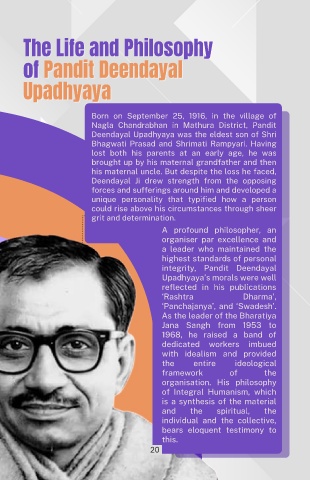
                        Born  on  September  25,  1916,  in  the  village  of             Shri Upadhyaya. Deendayal Ji in his economic policy
                                                                                          always emphasized on the welfare of the poorest of
                        Nagla  Chandrabhan  in  Mathura  District,  Pandit                the  poor.  The  last  man  in  the  society  was  at  the
                        Deendayal Upadhyaya was the eldest son of Shri                    centre  of  his  economic  thoughts.  He  said,  “The
                        Bhagwati  Prasad  and  Shrimati  Rampyari.  Having                success  of  economic  planning  and  economic
                        lost  both  his  parents  at  an  early  age,  he  was            progress  will  not  be  measured  through  those  who
                        brought up by his maternal grandfather and then                   are  at  the  top  of  the  society’s  ladder,  but  through
                        his maternal uncle. But despite the loss he faced,                the  people  at  the  lowest  rung  of  the  society.”  He
                        Deendayal  Ji  drew  strength  from  the  opposing                was  of  the  view  that  the  state  should  assure  a
                        forces and sufferings around him and developed a                  minimum standard of living for all individuals.
                        unique  personality  that  typified  how  a  person
                        could rise above his circumstances through sheer
                        grit and determination.
                                                                                          The ideal of ‘Integral Humanism’
                                          A  profound  philosopher,  an                   The ideal of ‘Integral Humanism’
                                          organiser  par  excellence  and
                                          a  leader  who  maintained  the                 He  propounded  the  philosophy  of  Integral
                                          highest standards of personal                   Humanism  which  discovers  the  threads  of
                                          integrity,  Pandit  Deendayal                   integration in apparent separateness. It is the idea
                                          Upadhyaya’s morals were well                    of  integration  of  individuals  with  society  and
                                          reflected  in  his  publications                nature and thus it gives freedom from conflict and
                                          ‘Rashtra             Dharma’,                   prejudice.  According  to  him,  Indian  tradition
                                          ‘Panchajanya’, and ‘Swadesh’.                   rejects  the  separateness  between  the  individual,
                                          As the leader of the Bharatiya                  society and nature and establishes its relationship
                                          Jana  Sangh  from  1953  to                     with  both  the  unconscious  and  conscious.  Every
                                          1968,  he  raised  a  band  of                  individual  of  the  society  is  mutually  linked,  this
                                                                                          world  is  not  an  alien  place,  this  earth  is  a  family
                                          dedicated  workers  imbued                      that  frees  us  from  the  ideas  of  separateness,
                                          with  idealism  and  provided                   alienation and dialectical relationship.
                                          the     entire     ideological
                                          framework         of      the                   Integral  humanism  rejected  the  intrinsic  diversity
                                          organisation.  His  philosophy                  based  on  race,  colour,  caste  or  religion,  it
                                          of  Integral  Humanism,  which                  identified  all  human  beings  as  part  of  this  one
                                          is  a  synthesis  of  the  material             organic  whole,  sharing  a  common  consciousness
                                          and     the   spiritual,   the                  of national thought. The people of all other faiths
                                          individual  and  the  collective,               and  sects  are  essentially  one  and  their  intrinsic
                                          bears  eloquent  testimony  to                  unity   should   be   based   on   this   common
                                          this.                                           consciousness of “Rashtriyata”.
                                       20
                                       20

